And Really, ANY So Called Chemical Drain Cleaners
Not only can they make the problem worse, they can cause other very costly problems. And they are dangerous for our employees who ultimately get called to address those problems.
Every plumber I’ve ever met has agreed on at least two things:
- Don’t install garbage disposals, and if you have one, REMOVE IT!
- Never, ever ever ever use “Drano” or any other so called chemical drain cleaner.
Since I am bringing it up, if you want to learn more about our dislike for garbage disposals, click here: https://www.ptcondo.com/garbage-disposals-high-rise-plumbing/
Might as well just pour cement down your drain.
But today, we are going to focus on ‘Drano’, because:
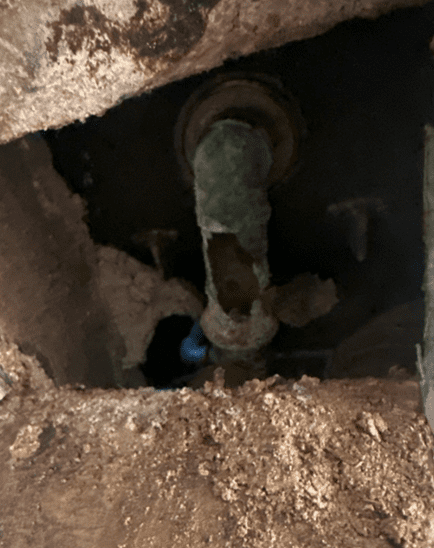
 While we can’t prove it 100%, it’s fair to say we’ve been around the block a few times when it comes to plumbing. There are many reasons our team believes this drain pipe was damaged by the use of Drano. Not from a single use, but probably over a period of time.
First, there is the obvious discoloration of the pipe. This is typically caused by chemicals. But there is also the location and size of the hole. Gravity as we know likes to bring liquids to the lowest point. Water eventually eats through iron pipes, yes, but we don’t typically see this size of hole. Normal aging typically leads to pin hole leaks and sediment build up which we do not see here. So, we believe Drano (or one of its equally evil brethren) was being used on this line, and tore right through the pipe.
Drano (and similar chemical drain cleaners) are terrible on plumbing. It’s a bad solution for use on any plumbing system. They are especially risky in high-rise buildings because of the way the drainage systems are shared and interconnected…and because of the scope. These chemicals don’t just disappear. They are working there way through hundreds of feet of pipe and can do damage right down to the very last inch.
Here’s why:
- Chemical drain cleaners can damage pipes and fittings…
- They are typically highly caustic (sodium hydroxide + aluminum) and generate heat when they react with water and organic matter.
- In older high-rise plumbing — especially if the building has iron drain lines such as Park Tower. The heat and causticity that is generated can corrode and weaken joints over time.
- There are horizontal lines that serve many units, and the chemicals can sit there and eat away at sections that weren’t even clogged.
- Risk of harming other units’ plumbing
- In a high-rise, your drain line is not just your drain line — it’s part of a shared waste stack.
- If the chemical doesn’t fully dissolve the clog in your section, the leftover caustic liquid can flow down into another apartment’s branches and damage their pipes, fixtures, or even splash someone if they’re working on a drain at the same time.
- Safety hazard for maintenance crews
- Building maintenance staff or plumbers who inevitably get called to deal with the problem, may work on a line after the chemical has been used.
- If the clog hasn’t cleared, they can be splashed, which can cause severe burns and eye injuries.
- In a high-rise where a single drain riser serves dozens of units, they may have no idea the chemical is present.
- It doesn’t fix the real problem in high-rises
- Many clogs in tall buildings are caused by scale buildup, grease accumulation deep in the stack, or venting issues — not just hair or food in your trap.
- Chemical drain cleaners might clear a little debris near the top, but if the blockage is 10 floors down, it won’t reach it effectively. The clog will return quickly, sometimes worse because loosened material can jam deeper in the line.
- It can cause heat damage
- There is an exothermic reaction that can heat up plumbing lines and soften and distort some seals. Heat can even cause damage to porcelain fixtures.
The example above is actually pretty severe. At Park Tower we’ve been fortunate enough over the years to not have a lot of examples pop up where we believe ‘Drano’ or other similar products have been used and caused damage.
This is a picture of a “tub shoe”, which is what the water drains through when it leaves a bathtub. It’s particularly vulnerable to products like ‘Drano’ because liquids move slower through lines that are more horizontal like this. And when there is gunk in the line (as there always is) it can sit there and eat away at the plumbing. In this case, we believe a chemical drain cleaner was used and eventually we had water running into other units below this bathtub, instead of down the drain.
SO PLEASE, contact our team for clogs. For most everyday clogs, THERE IS NO CHARGE! The exception being for extraordinary situations where we have to keep coming back because of something the resident does. Like flushing chicken bones down the toilet. True story…….more than once.