UPDATED September 25th
Illinois State Representative Kelly Cassidy Responds To Inquiries About Growing Presence Of Tents & Encampments And The Challenges They Present Throughout City Parks
“Good Afternoon,
Thank you for reaching out to share your concerns about the impact of tent encampments in our area. I apologize if this response has been delayed, but given the complexities of the laws that were cited in your messages, I wanted to do appropriate due diligence to properly address your questions.
As federal cuts to direct support programs like SNAP and Medicaid combined with cuts to funds for states and cities that supported social service programs mount, it’s an unfortunate reality that we will see the unhoused population grow as the cuts take effect. There’s no simple answer to the problem, but I do need to offer some context for the suggestion that the city is unable to address the encampments due to state laws on the issue.
In many of the messages we received, constituents mentioned that Alderwoman Manaa-Hoppenworth’s office shared the suggestion that the Safe-T Act and The Homeless Bill of Rights were at the heart of the problem and messages should be directed to our office. Having not had any contact with the Alderwoman’s office about her work to address the encampments prior to receiving your messages, this came as a surprise to me. When concerns grew in the 49th ward over an encampment in Touhy Park towards the end of the pandemic, our office worked very closely with Alderwoman Hadden to help support her office’s efforts to ensure that everyone in the park who could be connected to housing was and that others in the park who were contributing to dangerous conditions were held accountable. Communicating regularly and working together helped our office identify ways that the state could be of help such as assisting with reconnecting people with benefits that had lapsed while also ensuring that we were helping to make sure that residents in the area knew what was being done to mitigate the situation. It’s slow and painstaking work and frankly not everyone was happy about how long it took to clear the encampment, but honest and clear communication is critical to navigating these issues.
Based on the descriptions of issues that were shared in multiple messages, there is nothing in the Safe-T Act or any laws on homelessness that appear to be at play here. And if they were, there is nothing in the immediate term that could be done as we are not in session, so any changes to the laws would not come until next year at the earliest. Honestly, we often hear the Safe-T act invoked in these circumstances and it’s almost always out of a lack of understanding of what’s actually in the law – and it makes a handy excuse. While the Pretrial Fairness Act contained within the Safe-T Act did eliminate cash bond in Illinois, it did not create a “get out of jail free” situation. In fact, the population in the jail has actually ticked upwards slightly in the wake of the passage of the law. When I worked in the jail, it was a daily occurrence that someone who shoplifted a piece of fruit was in custody for lack of $50 for bond while a gang member charged with murder could bond out immediately because they had access to cash. The law also did not take away the ability for a judge to detain someone who is a danger to themselves or others, or to impose conditions on someone’s freedom. Many of the acts described in the emails were detainable offenses provided the prosecutor requested detention and the judge agreed.
The questions of the Homeless Bill of Rights are slightly more complex because there are multiple things that could refer to. The one that’s been most prominent refers to HB1429, which would prohibit a municipality from taking certain steps to criminalize homelessness. That bill has not passed, nor has Chicago attempted to create criminal penalties for sleeping in public the way other areas have. There are some underlying laws that do create protections for unhoused people, but again, if accurate, the conditions you describe in your messages certainly could meet the standards of public health or safety hazards that absolutely would allow for interventions.
To the fundamental question of clearing encampments: As I mentioned above, the unprecedented cuts to resources people and programs depend on for survival have made what was already a bad situation exponentially worse. The long waits for shelter beds (there’s an average wait of 117 days for shelter), the need to engage directly with individuals to complete assessments and file applications for placement and other programs, and the challenges of working with a population with a high incidence of mental illness and substance use disorders make it impossible to solve the problems quickly. If an encampment is cleared, the weeks or months of engagement with the individuals that can be helped is lost when the inhabitants of the area are forced to scatter and regroup in other places. Moving the problem elsewhere means it will take even longer to get folks into stable housing and supports to prevent recurrence while simply making the issues someone else’s problem.
There can and should be a balance here. The city and local service agencies on the ground seem to be working diligently to rehouse people. The city also can be aggressive in their enforcement of laws around public health and safety while not encroaching on someone’s human rights. There are likely folks living in the encampments who are equally frustrated by the harmful actions of others in the area as they are impacting their safety as well.
We are working to identify a date for a meeting via Zoom that we hope many of the folks who reached out to us can attend. We are currently reaching out to subject matter experts who can be helpful in clarifying the questions raised over the state laws in question and hope to have a date for a virtual meeting confirmed shortly and will be in touch as soon as we’re able to finalize details.
—
Office of Illinois State Representative
Kelly M. Cassidy
14th District
773-784-2002 (Phone)
Website: www.repcassidy.com
UPDATED September 14th
A quick guide to our elected officials who can be contacted to express your concerns about the growing presence of tents and encampment communities in the parks:
48th Ward – Alderwoman Leni Manaa-Hoppen
Ward Office: 773-784-5277
Direct: 773-352-1553
When communicating with the Alderwoman, her power is obviously influencing policy through the City Counsel and pressuring Park District officials to do more clean ups.
Illinois State Representative Kelly Cassidy – 14th District
District Office: 773-784-2002
Email: info@repcassidy.com
Illinois State Senator Mike Simmons – 7th District
District Office: 773-769-1717
E-message: https://www.senatormikesimmons.com/contact-us
For our State Representatives, the Alderwoman’s office has told us that STATE legislation such as what is referred to as the “Homeless Bill of Rights” protects what they call personal portable property such as tents and freedom to move in public areas. Also, legislation referred to as the “Safety Act” ties the authorities hands when they are responding to events or problems with tent dwellers and their accumulating belongings.
More specifics on this legislation:
Bill of Rights for the Homeless Act
SAFE-T Act
You can learn a lot about this legislation through simple Google searches.
To learn more about specific Chicago Park District policies related to tents and homeless encampments and how their presence is managed in the parks, visit this link: https://www.chicagoparkdistrict.com/park-policies
It is here you will find a guide we were told was authored by the Park District Board, titled “Homeless Encampments on Park District Property: Policy & Protocol”. It was explained that this guide was put together to help their staff handle encampments consistently on park district property across the City.
One thing of interest we took from this guide, is what they define as “Personal Portable Property” (aka PPP): PPP are items that can be easily relocated by an individual experiencing homelessness and are allowed in an Encampment. PPP does not include larger items such as chairs, couches, and grills, which are not allowed and may be
removed under certain circumstances. Personal possessions apparently protected from removal by the City include the tents themselves and “a sleeping bag or bedroll, not more than two coats, not more than two pairs of shoes or boots, not more than five blankets, and not more than three bags or suitcases, and such contents as may be contained in said bags or suitcases, personal documents (such as personal identification, birth certificates, legal documents, personal or family photographs, and bills), personal medication, eyeglasses, money, and jewelry.”
Some may infer that it is this policy which may be creating an environment which fosters the presence and growth of the encampments on park district land.
UPDATED September 11th
Neighborhood property managers including myself (Tim Patricio), Scott Turton from Park Tower, and those from 5445, 5455 and the Edgewater Beach Apartments (the pink building) met on Wednesday September 9th with reps of Alderwoman Leni Manaa- Hoppenworth and the Chicago Park District to discuss the growing tent dwellings and associated problems.
We have been communicating and meeting with representatives from the Alderman’s office and the Park District Director for approximately three years in an effort to address the ongoing issues affecting the area behind our building.
Unfortunately, we have yet to receive a clear or lasting solution. We understand the importance of respecting the rights and needs of individuals experiencing homelessness; however, we also believe there needs to be a balance that considers the safety, cleanliness, accessibility, and quality of life of residents and taxpayers who live adjacent to these public spaces.
We have been advised that certain areas are protected by ordinances that prohibit tents or encampments, but those same restrictions do not currently apply to the public spaces directly behind our building. This has made it very difficult to address the recurring concerns in that area.
Our conversations with the Alderman’s office and other officials have been frustrating because, despite raising these concerns repeatedly, we have not been presented with a sustainable solution.
We were also advised that many of the policies governing the use of our public spaces are established by city and state legislators, and unfortunately seem to allow a lot of what we are seeing without what some might consider to be reasonable restraints. And, even things that are not allowed such as grills/barbecues, furniture, obvious garbage and more, is allowed to accumulate without any meaningful action by the authorities or consequences. Residents who would like to see those policies reconsidered may wish to continue communicating their concerns directly to their elected representatives (City and State) and make their priorities known through the civic and electoral process.
As a group of managers, including some who also live in Edgewater or surrounding neighborhoods, we will continue advocating for solutions that consider the well-being, safety, and dignity of everyone who uses and lives near these public spaces.
ORIGINAL POST September 4th
Our Team Has Received A Growing Number Of Inquiries About Tent Dwellings In The Meadows And Elsewhere Nearby
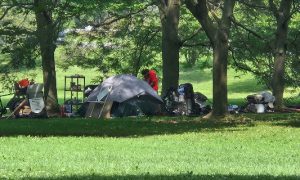
Many residents have likely observed this growing presence of tent encampments in nearby parks, alongside related issues like public litter, property misuse, and sanitation concerns.
We are aware of these conditions, and understand the worry and frustration some folks have expressed. South of Foster Avenue, encampments have grown into quite the communities, seemingly without any apparent restraint. As members of the Edgewater community, we all share these concerns and desire a firmer commitment to keeping our surrounding parklands safe, clean, comfortable and accessible.
Our team recognizes the deep complexities surrounding homelessness and housing insecurity in Chicago, but we also understand that our residents and Owners want to ensure our public spaces remain safe and sanitary, so they can be enjoyed by your families and neighbors. For our part, management has been pressuring the 48th Ward team to do more, and we have a meeting at Alderwoman Leni Manaa-Hoppenworth’s office the week of September 7th.
Residents and Owners can make their voices heard too. And the more people who act, the more likely there will be a meaningful response. If you wish to report specific issues such as litter, excess debris and sanitation, or let your voice be heard by local officials in a position to directly address the tent dwelling issue, here are suggestions to communicate most effectively:
1. Utilize Chicago 311 for Specific Actions
The city tracks service requests through its 311 platform. Instead of making broad complaints, your reports will be resolved faster if they target specific, actionable categories. You can download the CHI311 mobile app, file reports online at the Chicago 311 Service Portal, or call 311.
-
- For Litter, Trash, and Hazardous Waste: File a report under “Public Way Service Request” or “Garbage/Debris Overcrowding.” Specify the exact park location or intersection.
- For Public Sanitation Concerns: Report public urination, defecation, or biohazards under “Street Cleaning” or contact 311 to request a sanitation inspection for the affected park zone.
- To Request Outreach Services: If you believe individuals are in immediate need of shelter, medical attention, or social services, you can explicitly request a “Homeless Outreach Wellness Check” through 311. The city partners with the Department of Family and Support Services (DFSS) to send trained professionals to offer housing and mental health resources.
Note: Always request and save your 10-digit 311 tracking number so you can follow up on the status of the city’s response.
2. Engage the 48th Ward Alderwoman’s Office
Our Alderman is responsible for directing ward-specific resources and advocating for our neighborhood at City Hall. Emailing or calling the ward office with your tracked 311 numbers is highly effective.
-
- Contact: Visit the official 48th Ward Website Office Page to find the current office hours and other current information. https://the48thward.org/office-info
- Phone 773-784-5277 or E-mail info@the48thward.org
- What to Say: State that you are a resident of Park Tower Condo. Provide a concise, factual description of the issue (e.g., date, specific park area, and the exact problem like blocked walkways or accumulated trash) and include your 311 reference numbers.
- Tone Tip: Focus your message on public health, safety, and park accessibility. Advise the office on how these conditions affect your usage of the neighborhood infrastructure.
3. Attend Local CAPS (Chicago Alternative Policing Strategy) Meetings
For broader concerns regarding public safety or illegal activity, residents are encouraged to attend our local police district’s CAPS meetings. Park Tower is located within the 20th Police District.
- These meetings provide a direct forum to speak face-to-face with neighborhood relations officers and the district commander.
- You can track upcoming meeting dates, times, and community locations directly on the Chicago Police Department 20th District Calendar